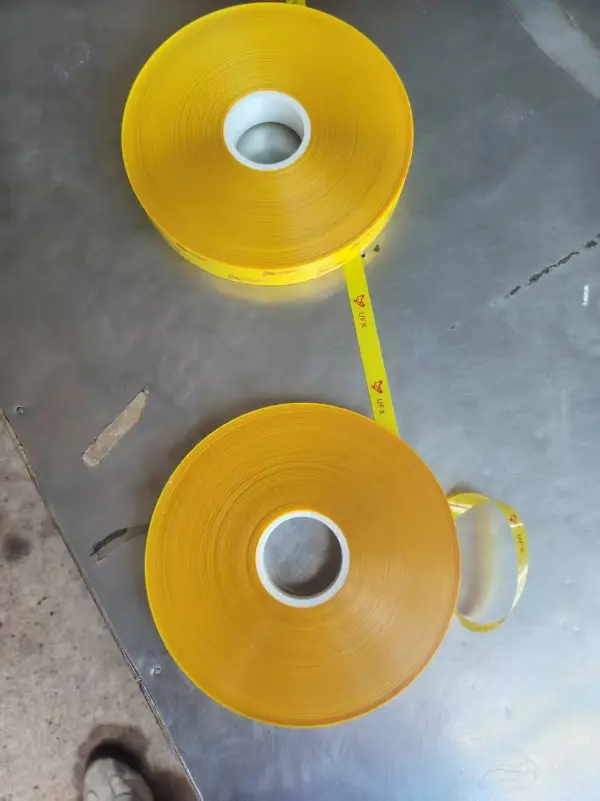

PET film, especially when rolled into rolls, often exhibits a yellowish or grayish color, easily visible to the naked eye. For yellow streaks, the film must be unfolded and observed against the light, or placed on a white backing for better identification.
Cause Analysis: Similar to gel spots, yellow spots, and black spots, yellowing is caused by poor thermo-oxidative stability of the resin or excessive air entering the extruder. When the resin produces a large amount of acetaldehyde during thermal oxidation, the acetaldehyde reduces antimony trioxide to antimony, causing the film (resin) to turn gray. Yellow streaks often appear after filter replacement or resin replacement. This is because air may have entered during replacement, or some resin may have remained in the machine for too long. This causes some resin to yellow, and this yellowed resin cannot be fully mixed with the normal melt plasticizing process, resulting in yellow streaks.
A characteristic of static electricity is adsorption. Rubbing the surface of the PET film... Static electricity can be generated during various processes, including the unwinding and peeling of the film roll, and high-speed operation of the film. If dust, paper scraps, hair, etc., are present near the film, they can be attracted to it, affecting the quality of the product film (especially capacitor film). Severe static electricity can even cause fires and electric shocks. It is known that excessive static electricity in polyester films has adverse effects on subsequent processing and the finished product. For example, the static electricity of bonded PET films can be measured with an electrostatic meter, typically around 500V. Measurements show that the static electricity on both sides of the film is different.
PET film is a polar, electrically insulating material. This prevents the discharge of charges generated by friction, shearing, etc., from dissipating, causing them to accumulate on its surface and form static electricity. The static electricity of PET film is related to the electrical properties of the resin itself, the application of additives, and the film-forming process. These factors directly affect the structure and properties of the film surface/facets, such as the crystallinity of the surface layer, the number and orientation of polar groups, and the size of the contact area between the two film surfaces, all of which influence static electricity formation. This also explains why the static electricity on the two sides of the film differs.
Identify the causes in the resin, additives, and process and address them accordingly;
Use static eliminators in film-forming and post-processing;
Coat the surface with a conductive agent;
Use antistatic agents/resins. 3. Insufficient Adhesive Strength
The adhesive strength of printed, laminated, and vacuum-metallized films is usually tested using self-adhesive tape. There are three possible outcomes: complete peeling, partial peeling, and non-peeling. The first two indicate insufficient adhesive strength.
Cause Analysis: The adhesive strength between PET film and ink/adhesive is limited by the surface tension of the PET film. Untreated PET film has a surface tension of 42-48 N/s, which is insufficient to meet the required adhesive strength with ink/adhesive. Therefore, production processes must implement measures such as corona treatment to increase the surface tension to above 55 N/cm.